

Marilyn Price-Mitchell, PhD

Marilyn Price-Mitchell, PhD, is a developmental psychologist, researcher, author, and founder of Roots of Action. Her professional life has been guided by a deep interest in human growth: how people discover their strengths, navigate change, develop a sense of purpose, and contribute to something larger than themselves.
During a career spanning more than five decades, she worked first with leaders in organizations and later with children, families, schools, and communities. Although the settings changed, the central questions remained consistent:
What helps people thrive? What kinds of relationships and experiences foster growth? How can institutions support human potential while remaining true to their missions and values?
These questions eventually led Dr. Price-Mitchell to develop the Compass Advantage, a positive youth development framework that identifies eight interconnected attributes young people need to navigate their lives from the inside out.
Career in Organization Development
Price-Mitchell spent the first part of her career in the field of Organization Development, consulting with corporations, nonprofit organizations, and their leaders.
She earned a master’s degree in Human Resource Development in 1980 from University Associates and spent more than 25 years helping organizations strengthen their capacity to learn, adapt, and work effectively.
Her consulting included strategic planning, executive coaching, team building, and leadership development. Rather than bringing a predetermined formula to an organization, she focused on understanding its mission, culture, challenges, and aspirations. Her role was to help people clarify what mattered, work through complexity, improve relationships, and translate shared goals into meaningful action.
A student of Gregory Bateson and Joseph Campbell at Esalen Institute in the late 1970s, she encountered two perspectives that would become central to her life work. Bateson introduced her to systems thinking—the understanding that people do not grow in isolation but are shaped by relationships, organizational cultures, social expectations, and opportunities for purposeful participation. Campbell deepened her interest in the inner journey: how people find meaning, confront obstacles, and grow through life’s challenges.
Together, these influences reinforced her belief that lasting change cannot simply be imposed from the outside. Individuals and organizations must develop the awareness, skills, and internal commitment to navigate change for themselves and move forward with purpose.
A Focus on Human Development
As Price-Mitchell’s career evolved, she became increasingly interested in how the foundations of adulthood are formed during childhood and adolescence.
She returned to graduate study, earning a second master’s degree in Human and Organizational Systems and, in 2010, a doctorate in Human Development from Fielding Graduate University. She refocused her work on supporting families, schools, and communities in their efforts to raise and educate the next generation of innovative workers, engaged citizens, caring family members, and ethical leaders.
For fifteen years, she was a fellow with Fielding’s Institute for Social Innovation. Her work integrated knowledge from developmental psychology, education, systems theory, organizational development, neuroscience, civic learning, and positive youth development.
Price-Mitchell approached education as far more than the acquisition of knowledge or preparation for employment. At its best, education helps young people understand themselves, relate meaningfully to others, think critically, make ethical choices, adapt to change, and discover how they can contribute to the world around them.
Academic learning matters greatly. But grades and test scores alone cannot reveal whether a young person is developing strengths like resilience, compassion, integrity, and the capacity to collaborate with others.
Those internal attributes became the heart of her later work.
Learning from Civically Engaged Young People
Price-Mitchell’s doctoral research examined the developmental stories of civically engaged young people. She wanted to understand how they came to see themselves not merely as students or future workers, but as people capable of making a meaningful difference.
Their stories revealed that civic engagement rarely develops from classroom instruction alone. Young people learn to participate in democratic society through relationships and lived experience. They grow when adults take them seriously, when they encounter issues that matter to them, and when they are invited to act rather than simply observe.
They also benefit from experiences that stretch them beyond the familiar—working with people from different backgrounds, confronting difficult questions, recovering from mistakes, and reflecting on what they are learning about themselves and the world.
Following her doctoral studies, Price-Mitchell received the Elizabeth Douvan Postdoctoral Fellowship to continue her research. That work contributed to resources developed for Points of Light; Design for Change USA; Youth Work Scotland, Aurora for Training and Development in Amman, Jordan, and numerous community-based youth initiatives. Her research and its application became the foundation of her book, Tomorrow’s Change Makers: Reclaiming the Power of Citizenship for a New Generation.
Her book explored how families, schools, and communities help young people develop agency, purpose, and a commitment to the common good. It challenged the idea that adults can prepare children for the future simply by directing them toward conventional markers of success.
Young people also need opportunities to wrestle with questions that cannot be answered on a test:
- Who am I?
- What do I value?
- Where do I belong?
- What am I capable of doing?
- How should I respond when life does not go as planned?
- What responsibility do I have to others?
The Compass Advantage
The Compass Advantage grew from Price-Mitchell’s research and her effort to synthesize knowledge across disciplines. The framework identifies eight abilities that help young people thrive, all of which can be explored in depth from this site.
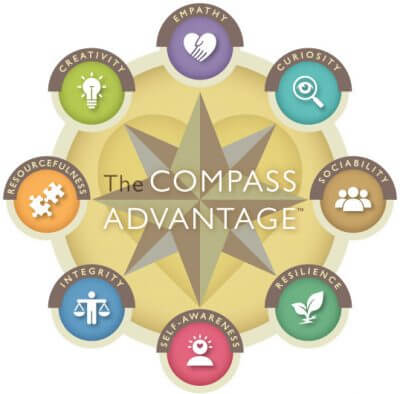
Price-Mitchell did not view these as isolated personality traits or another checklist by which children should be judged. They are dynamic, interconnected capacities that develop through a child’s lived experience. Together, they create a shared language for positive youth development–a way to help young people notice how they learn, relate, solve problems, and make choices.
Curiosity encourages learning and discovery. Empathy and sociability help young people build relationships across differences. Self-awareness supports integrity and sound decision-making. Creativity makes it possible to imagine new approaches, while resourcefulness and resilience help transform ideas into action and sustain effort through difficulty.
The compass metaphor reflects a central belief throughout Price-Mitchell’s work: adults cannot chart every step of a child’s life, nor can they predict the world young people will inherit. In addition to providing them with a quality academic education, adults must help children develop the inner resources needed to discover their own direction.
The goal is not to engineer a particular kind of child. It is to create environments in which young people can gradually become the authors and navigators of their own lives.
Bridging Research and Everyday Life
Price-Mitchell founded Roots of Action in 2011 to translate research in child and adolescent development into practical guidance for the adults who influence young people every day. In less than a decade, it grew to over 3 million visitors annually, including parents and educators from across the globe who used its free resources in homes and classrooms.
As a scholar-practitioner, Price-Mitchell was most interested in research that changed how people understood familiar experiences. A conversation at the dinner table, a conflict with a friend, a disappointing grade, a community-service project, or a relationship with a caring teacher could all become part of a young person’s development.
Her writing and public speaking encouraged parents and educators to look beneath outward performance and become curious about the internal growth taking place:
- What is this young person learning about herself?
- Which strength is being tested or developed?
- When does support become overprotection?
- How can an adult offer guidance without taking over?
- What allows challenge to become a source of growth?
- How do children learn that their value is greater than their accomplishments?
Price-Mitchell believed adults matter profoundly in children’s lives, but not because adults can control children’s futures. Adults matter because they help create the relational and emotional conditions in which young people feel known, challenged, supported, and increasingly capable of directing their own development.
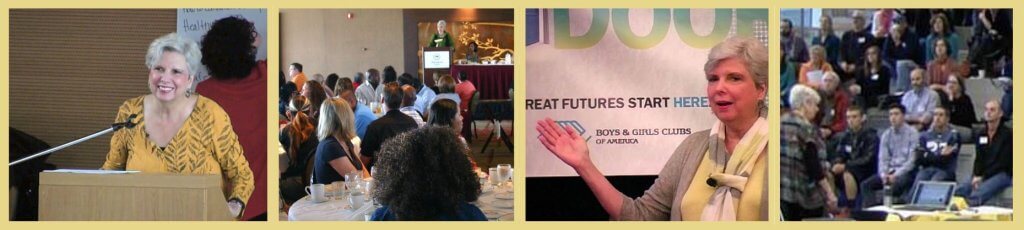
Dr. Marilyn Price-Mitchell speaking to audiences of parents and educators.
Rethinking Success
One of the strongest themes running through Price-Mitchell’s work is the need for a broader definition of success.
She did not view academic achievement as unimportant. Knowledge, discipline, and sustained effort can expand a young person’s opportunities. But when achievement becomes the primary measure of childhood, education risks losing sight of the person who is developing beneath the résumé.
A young person can earn excellent grades and still struggle to understand herself, cope with adversity, build healthy relationships, or find meaning. Another may follow a less celebrated path while developing wisdom, creativity, compassion, and a strong sense of purpose.
Education should therefore prepare young people not only to make a living, but also to build a life.
It should help them become capable thinkers and humane people—individuals who can make thoughtful choices, adapt to uncertainty, care for others, act with integrity, and participate constructively in their families, workplaces, and communities.
This understanding of human development connected Price-Mitchell’s two careers. Whether working with executives, organizational teams, parents, teachers, or young people, she remained interested in the development of inner capacity rather than the imposition of external answers.
A Legacy of Questions, Not Formulas
Price-Mitchell retired from her career and active publishing in 2026 and preserved Roots of Action as a permanent educational resource for parents, educators, and youth mentors.
This site represents a substantial body of work, but she does not view the Compass Advantage—or any developmental framework—as a formula for raising successful children. Human development is too complex, individual, and relational to be reduced to a series of prescribed steps.
Instead, her work offers adults a way to notice more deeply, ask better questions, and act with greater intention.
Her legacy is grounded in a hopeful view of young people. Children are not empty vessels waiting to be filled or products waiting to be perfected. They are active participants in their own development.
When young people experience meaningful relationships, appropriate challenges, opportunities for reflection, and the freedom to contribute, they begin to discover their own capacities. They learn not only how to succeed, but also who they are and what kind of people they hope to become.
That process—helping youth develop the inner compass to lead purposeful and engaged lives—has been the central work of Marilyn Price-Mitchell’s career. Across both parts of her career, Price-Mitchell’s work centered on helping people develop the awareness, relationships, and inner capacities needed to lead purposeful lives and contribute to the communities around them.
Beyond career, Price-Mitchell continues to engage in meaningful conversations and activities that improve the common good for all age groups, especially those who are misunderstood, marginalized, or suffering. She has been an active member of the international Threshold Choir, singing at the bedsides of those who are ill or dying. As a volunteer Compassionate Companion for a local nonprofit, she’s supported many individuals grieving the loss of loved ones. She created and co-led a walking group for widows, using the metaphors of nature to help process group members’ paths through grief. Her interests span from child development to intentional aging, eldercare, and end-of-life. She’s excited about her next life chapter!
Selected Career Milestones
- Earned a B.A. in Sociology from the University of Michigan, 1972.
- Earned an M.A. in Human Resource Development from University Associates, 1980.
- Built a 25-year career in Organization Development, consulting with corporations and nonprofit organizations in strategic planning, executive coaching, team development, and leadership.
- Designed and led ParentNet®, a program created to strengthen parent-school communities, and co-founded the National ParentNet Association, 1997–2014. The work was later expanded by the nonprofit Washington Family Engagement.
- Earned an M.A. in Human and Organizational Systems from Fielding Graduate University, 2008.
- Earned a PhD in Human Development from Fielding Graduate University, 2010.
- Received the Elizabeth Douvan Postdoctoral Fellowship.
- Founded Roots of Action and developed the Compass Advantage framework, 2011.
- Served as a fellow at Fielding Graduate University’s Institute for Social Innovation, 2011–2026.
- Conducted and synthesized research in positive youth development, civic engagement, adolescent life satisfaction, and family-school-community partnerships.
- Published Tomorrow’s Change Makers: Reclaiming the Power of Citizenship for a New Generation, 2015.
- Authored peer-reviewed research, including “Boundary Dynamics: Implications for Building Parent-School Partnerships” and “Factors Associated with Life Satisfaction in Adolescents: Implications for Families and Schools.”
- Applied her research in collaboration with youth-development programs in the United States and abroad.
- Wrote for Edutopia, Psychology Today, and other national platforms. Quoted and/or interviewed by The Atlantic, PBS, PsychCentral, PTO Today, neaToday, New York Times, and Huffington Post.
- Delivered keynote presentations and workshops to thousands of parents and educators nationwide.
- Retired from active consulting and publishing in 2026.
Explore Price-Mitchell’s Work
Explore the research, frameworks, and practical resources developed by Marilyn Price-Mitchell.
- About Roots of Action – Learn how to use the Roots of Action website as a parent, teacher, or youth mentor and best places to begin your reading.
- The Compass Advantage — Explore the eight internal abilities that help young people thrive.
- Research — Browse research on life satisfaction in adolescence, youth civic engagement, and the relationship between human development and thriving.
- Articles — Browse almost 150 articles with practical guidance for parents, teachers, and youth mentors.
- Tools and Guides — Access free resources designed to help adults apply the principles of positive youth development, including downloadable guides and eBooks, visuals & printables, and handouts for home and classroom.
- Tomorrow’s Change Makers — Learn how relationships and transformative experiences help young people become engaged citizens.