
Teachers often see more in a student than a report card can show. They notice the child who asks an unexpected question, repairs a friendship, tries a second strategy, admits a mistake, or finds the courage to ask for help.
These moments matter.
Yet when educators talk with students and families about such growth, they do not always have words that are both developmentally meaningful and easy to use.
The problem is not a lack of knowledge. Positive youth development and social and emotional learning (SEL) have given educators a substantial research base for understanding what helps young people learn, form healthy relationships, adapt to difficulty, and contribute to their communities. The Search Institute’s Developmental Assets framework has also helped schools and communities recognize the internal strengths and external supports young people need.
Helping Students, Teachers and Families Talk about Learning, Relationships, and Growth
While research has helped shape knowledge in positive youth development, scientifically useful ideas do not automatically become everyday language. A comprehensive framework may serve researchers, school leaders, and program designers very well while still being difficult for a fourth grader to remember or for a parent to use at the dinner table. The challenge is translation: How can we make developmental knowledge easier to recognize, discuss, and practice without flattening its complexity?
The Compass Advantage offers one answer. It organizes many familiar ideas from developmental science into eight accessible strengths: curiosity, creativity, empathy, integrity, resilience, resourcefulness, self-awareness, and sociability. Together, they create a shared language for positive youth development—a way to help young people notice how they learn, relate, solve problems, and make choices.
The Compass is not a replacement for SEL, Developmental Assets, character education, or other respected approaches. Nor is it a diagnostic tool or a prescribed curriculum. It is a research-based and concise developmental lens that can help important ideas travel more easily among classrooms, students, and families.
What Positive Youth Development and SEL Have Taught Us
Positive youth development changed the central question adults ask about children. Instead of focusing primarily on risks and deficits, it asks what relationships, opportunities, strengths, and contexts help young people thrive. Major PYD models—including the Five Cs and Developmental Assets—view development as relational: children grow through ongoing interactions with families, peers, schools, and communities (Lerner et al., 2005; Benson, 2007; Shek et al., 2019).
SEL brought closely related insights into education. CASEL describes five broad, interrelated areas: self-awareness, self-management, social awareness, relationship skills, and responsible decision-making. Importantly, the current CASEL framework places these competencies within classrooms, schools, families, and communities rather than treating them as skills that reside only inside a child.
The evidence for well-designed school-based SEL is substantial. A landmark meta-analysis of 213 universal programs found benefits for students’ social-emotional skills, attitudes, behavior, and academic performance (Durlak et al., 2011). A more recent meta-analysis, covering 424 studies from 53 countries, also found generally positive effects while documenting wide variation in programs, outcomes, and implementation (Cipriano et al., 2023).
Developmental Assets contributes a particularly helpful ecological view. Its 40 assets include 20 external supports and opportunities—such as family support, adult relationships, boundaries, and constructive use of time—and 20 internal qualities, including commitment to learning, positive values, social competencies, and positive identity. Its breadth is a strength because it reminds us that children’s development cannot be separated from the environments adults create.
These frameworks do different work, and schools need that depth. Yet depth can create a communication challenge. An educator may understand how a classroom practice supports responsible decision-making, relationship skills, student agency, developmental relationships, and positive identity. A student may simply need a memorable question: Which strength could help me here?
The Compass as a Developmental Language
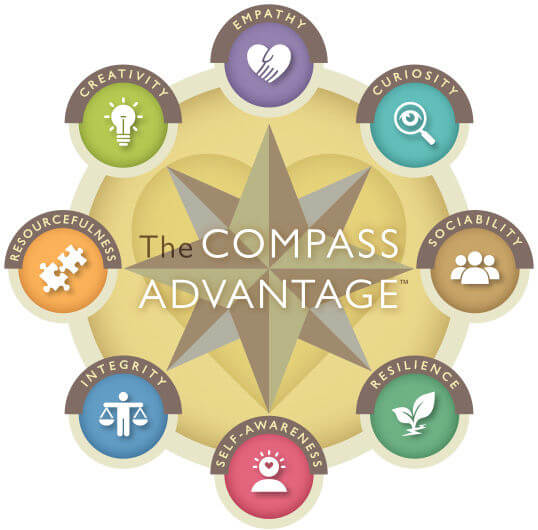
A compass does not prescribe one route or tell a traveler who to become. It helps a person notice direction. In the same way, the Compass Advantage gives young people eight points of orientation.
Curiosity draws students toward questions, new knowledge, and perspectives they have not yet considered. Learn More: Teachers | Parents
Creativity helps them imagine possibilities, express ideas, and try something original. Learn More: Teachers | Parents
Empathy invites them to understand another person’s experience and respond with care, even when they do not agree. Learn More: Teachers | Parents
Integrity brings values and actions into conversation: What matters to me, and does my choice reflect it? Learn More: Teachers | Parents
Resilience helps a young person adapt and recover when something is hard; it does not mean hiding pain or managing without support. Learn More: Teachers | Parents
Resourcefulness turns toward possible tools, strategies, people, and next steps. Asking for help can be an especially mature form of resourcefulness. Learn More: Teachers | Parents
Self-awareness helps students notice their emotions, values, patterns, strengths, and needs. Learn More: Teachers | Parents
Sociability supports belonging, communication, cooperation, and repair. It is not a synonym for extroversion. Quiet listening, working comfortably with one trusted partner, using an assistive communication device, or knowing when to step away from an overstimulating interaction may all reflect social strength. Learn More: Teachers | Parents
No child uses all eight strengths equally in every situation. They develop over time, influence one another, and are shaped by context. A curious question may spark creativity. Self-awareness may help a student recognize that resilience requires rest or assistance. Empathy and integrity may work together when a young person decides to challenge an unfair remark.
The purpose is not mastery. It is awareness, practice, and growth.
What This Sounds Like in Everyday Life
During classroom instruction
Teacher: “We have tried the first method, and it did not work. What would resourcefulness look like now?”
Student: “We could check the model, ask another group what they noticed, or try drawing the problem.”
During student reflection
Student: “I thought resilience meant I should keep working alone. Now I think asking for a quieter place and more time was both resilience and resourcefulness.”
During feedback
Teacher: “Your curiosity is visible in the questions you asked. Which strength might help you decide which question to investigate first?”
During conflict
Student: “I can understand why she was upset without agreeing with what she said.”
>Teacher: “That is empathy with integrity. What might repair look like?”
At home
Parent: “You did not get the part you wanted. Do you need comfort first, or are you ready to think about what resilience might look like tomorrow?”
At a family conference
Teacher: “Jordan contributes carefully considered ideas in a small group. I see sociability in the way Jordan listens and helps the group connect ideas.”
One Vocabulary Across School and Home
A shared vocabulary becomes useful when it moves rather than stays on a poster.
In a science class, curiosity may help students generate questions while resourcefulness helps them revise an investigation. When reviewing literature, empathy can open a character’s perspective while integrity invites discussion of competing values. In mathematics, creativity appears in multiple solution paths and resilience in the decision to learn from an error. During group work, sociability includes listening, negotiating roles, communicating needs, and repairing misunderstandings.
The same words can then travel into reflection. Instead of “I’m bad at group projects,” a student might say, “I share ideas easily, but I want to practice listening when the group chooses another direction.” Instead of “I have no creativity,” a student might notice, “My creativity shows up in designing experiments, not usually in drawing.” Language turns a global judgment into something observable and developmental.

Families can use the words without becoming teachers at home. A parent might ask over dinner, “Which strength helped you today?” or “Which one could support you tomorrow?” A young person might answer, “I used integrity when I told my friend the truth,” or “I need resourcefulness because my plan is not working.” Such exchanges do not require parents to know educational terminology. They invite families into the same developmental conversation. Learn how purposeful parents use the Compass as a tool for raising successful kids.
The vocabulary can also deepen conferences. Academic evidence still matters, but it becomes part of a fuller picture: What helps this student engage? How do they respond to challenge? Where do they find belonging? What do adults see differently at home and at school? The student should be part of that conversation, not its object.
How the Compass Complements SEL and Developmental Assets
The three approaches overlap, but they are not interchangeable.
| Approach | Primary contribution | Typical structure | Everyday use | Evidence status |
| Social and emotional learning (SEL) | Develops knowledge, skills, and attitudes that support identity, emotion management, relationships, decisions, learning, and well-being | CASEL’s five competencies situated across classroom, school, family, and community contexts; many distinct programs and practices | Guides schoolwide planning, instruction, climate, and skill development | Large, international intervention literature and multiple meta-analyses; effects vary with program, context, implementation, and outcome |
| Developmental Assets | Identifies the internal strengths and external relationships, opportunities, and supports young people need | 40 assets: 20 external and 20 internal | Supports community assessment, planning, relationship-building, and a broad ecological view of development | Longstanding applied research across large youth samples; specific studies vary in design and population |
| Compass Advantage | Translates developmental research into a memorable, strengths-based vocabulary for reflection and conversation | Eight interconnected internal strengths | Helps teachers, students, and families notice, name, discuss, and practice development in ordinary moments | One qualitative foundational study and one 2024 cross-sectional correlational study. |
SEL offers a broad field and a strong intervention literature. Developmental Assets helps communities keep both young people’s inner strengths and their external supports in view. The Compass provides a smaller set of words and concepts that can make developmental conversation easier.
The Compass, as a framework, was developed to translate a vast body of PYD research into practice. In a 2024 cross-sectional study of 602 eighth- and ninth-grade students, measured Compass attributes were positively associated with life satisfaction (Price-Mitchell & Clay, 2024).
The smaller vocabulary of the Compass necessarily leaves things out. It does not explicitly catalog external supports, institutional conditions, emotion regulation, or every dimension of identity and development. Educators should not use its simplicity to locate responsibility solely within students. A child cannot “resilience” their way out of an unsafe, inaccessible, or unjust environment. Adults remain responsible for creating supportive conditions and changing harmful ones.
Use the Language Without Turning It Into a Label
A strengths vocabulary can become harmful if adults turn it into a ranking system: “resilient students” and “nonresilient students,” “high empathy” and “low sociability.” These terms should open inquiry, not close it.
Children express strengths differently across culture, temperament, age, language, disability, and neurodevelopment. Direct eye contact may be read as sociability in one context and disrespect in another. A student who speaks little in a large group may connect deeply one-to-one. Empathy may appear through words, practical action, careful observation, art, or advocacy. Self-awareness may be communicated verbally, through movement, with visual supports, or after time to process.
Context also changes expression. Anxiety, trauma, sensory overload, racism, language demands, inaccessible instruction, or fear of judgment may obscure a strength that is visible elsewhere. Culturally responsive SEL scholars warn against treating dominant norms of behavior as universal competence (Jagers et al., 2019; Cipriano et al., 2023).
For that reason:
- Do not diagnose, grade, or publicly compare students by Compass strengths.
- Describe observable moments rather than assigning identities: “You asked for another strategy” is more useful than “You are resourceful.”
- Ask students what a strength means and looks like in their lives.
- Treat behavior as contextual information, not proof of an inner deficit.
- Examine the environment: What support, access, safety, relationship, or choice would make this strength easier to express?
The Compass should enlarge adults’ capacity to notice young people, not narrow young people to eight words.
Getting Started: For Educators
You do not need a separate eight-unit curriculum to begin using the Compass. Choose one strength already present in the life of your classroom. Introduce the whole Compass briefly so students can see the larger map, then return to the one word when it is genuinely useful. Many classrooms use a posted graphic of the compass for easy reference and discussion. See Tools & Guides for graphics, handouts, etc.
Before a project, ask, “Which strengths might this work call upon?” During difficulty, ask, “What is happening, and which strength—or support—could help?” Afterward, invite reflection: “Which strength did you use? Which one surprised you? What did someone else contribute?”
Listen for how students define the words. Invite families to add examples from home and community. Notice expressions you might otherwise miss. Revisit the vocabulary during ordinary learning, not only when something has gone wrong.
The goal is not to complete the Compass. It is to give young people and the adults around them a humane, memorable way to talk about who they are becoming—and how they can help one another grow.
References
Benson, P. L. (2007). Developmental assets: An overview of theory, research, and practice. In R. K. Silbereisen & R. M. Lerner (Eds.), Approaches to positive youth development (pp. 33–58). SAGE. https://doi.org/10.4135/9781446213803.n2
CASEL. (2020). CASEL’s SEL framework. https://casel.org/fundamentals-of-sel/
Cipriano, C., Strambler, M. J., Naples, L. H., Ha, C., Kirk, M., Wood, M., Sehgal, K., Zieher, A. K., Eveleigh, A., McCarthy, M., Funaro, M., Ponnock, A., Chow, J. C., & Durlak, J. (2023). The state of evidence for social and emotional learning: A contemporary meta-analysis of universal school-based SEL interventions. Child Development, 94(5), 1181–1204. https://doi.org/10.1111/cdev.13968
Durlak, J. A., Weissberg, R. P., Dymnicki, A. B., Taylor, R. D., & Schellinger, K. B. (2011). The impact of enhancing students’ social and emotional learning: A meta-analysis of school-based universal interventions. Child Development, 82(1), 405–432. https://doi.org/10.1111/j.1467-8624.2010.01564.x
Jagers, R. J., Rivas-Drake, D., & Williams, B. (2019). Transformative social and emotional learning (SEL): Toward SEL in service of educational equity and excellence. Educational Psychologist, 54(3), 162–184. https://doi.org/10.1080/00461520.2019.1623032
Lerner, R. M., Lerner, J. V., Almerigi, J. B., Theokas, C., Phelps, E., Gestsdóttir, S., Naudeau, S., Jelicic, H., Alberts, A., Ma, L., Smith, L. M., Bobek, D. L., Richman-Raphael, D., Simpson, I., Christiansen, E. D., & von Eye, A. (2005). Positive youth development, participation in community youth development programs, and community contributions of fifth-grade adolescents. The Journal of Early Adolescence, 25(1), 17–71. https://doi.org/10.1177/0272431604272461
Price-Mitchell, M., & Clay, B. (2024). Factors associated with life satisfaction in adolescents: Implications for families and schools. School Community Journal, 34(2), 53–86. https://www.adi.org/journal/FW2024/PriceMitchell%26Clay.pdf
Search Institute. (n.d.). Developmental Assets framework. https://searchinstitute.org/resources-hub/developmental-assets-framework
Shek, D. T. L., Dou, D., Zhu, X., & Chai, W. (2019). Positive youth development: Current perspectives. Adolescent Health, Medicine and Therapeutics, 10, 131–141. https://doi.org/10.2147/AHMT.S179946
Other Related Resources
RELATED TOPICS:
Published: August 2, 2026
Tags: education, Family-School Partnerships, positive youth development