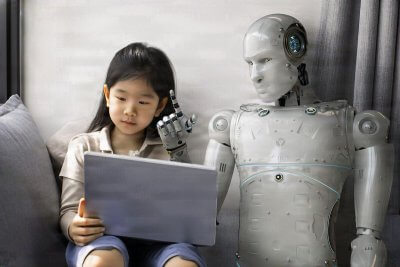
Fifteen years after founding Roots of Action, I’m writing my last article here as I ponder the future of AI and human development. Artificial intelligence is giving us new ways to learn, work, and navigate everyday decisions. It also raises questions about how young people will develop a sense of self, build relationships, and learn to direct their lives. For educators and parents, these questions reach beyond what a tool can do to what children experience as they use it.
One recent study offers a useful starting point. In a high school mathematics experiment in Turkey, students using a generative AI tool that readily supplied answers performed better during practice but worse than the comparison group when they later worked without it. A version designed to guide students with teacher-informed hints largely avoided that disadvantage. Doing better with help and learning something we can carry forward are different outcomes.
That distinction connects a new technology to a longstanding concern of youth development: How do we help young people build capacities they can carry into the rest of their lives?
Fifteen Years of Positive Youth Development
When I began Roots of Action in 2011, I wanted to help change the conversation about children. Too often, the discussion I encountered centered on what was wrong, what needed fixing, or how to prevent the next problem. I wanted more attention paid to what was growing within young people—their curiosity, creativity, empathy, and capacity to make a difference.
Positive youth development already had an important foundation in research and practice. Its strengths-based approach offered a broader view of young people and of the relationships, opportunities, and environments that helped them thrive. My hope was to make that understanding more accessible to the adults who influence children’s everyday lives.
Over these fifteen years, I have watched that conversation broaden. Today, I encounter far more articles and resources about nurturing children’s strengths, supporting their agency, and helping them find meaning and belonging. There is still work to do. But I feel proud that Roots of Action has made even a small contribution to a conversation now shared by so many educators, parents, researchers, and youth-development professionals.
As this understanding has become more widely shared, we are entering another period of change. Generative AI is becoming part of the settings in which young people learn and grow. The strengths we have worked to bring into clearer view give us a place to begin asking what these tools might support, what they might displace, and how we want to use them.
My interest in human development took root in the late 1970s at Esalen Institute in Big Sur, CA, where I studied with Gregory Bateson and Joseph Campbell. Bateson’s systems theory shaped my work in the fields of organization development, then in family school partnerships. It was Campbell who first encouraged me to explore my inner self through what he called the Hero’s Journey. Looking back, I can see how those early experiences led me to create the Compass Advantage, a framework for fostering children’s inner strengths.
Those influences also help explain why I am interested in more than what artificial intelligence can do for us. I want to understand how it becomes part of the relationships and experiences through which we develop. How might it influence the questions we ask, the possibilities we imagine, and our sense of what matters?
Decades later, I am still exploring the inner journey—now as someone preparing for retirement, as well as a developmental psychologist thinking about the lives young people will live into adulthood. That exploration leaves me with a question I want to carry into my next chapter: How can we use artificial intelligence in ways that strengthen our capacity to direct our lives?
Questions About AI and Human Development
When I have questions about human growth and well-being, I often imagine myself at a cocktail party with fellow social scientists. What would we be discussing? Where would we disagree? What question might follow me home?
Today, I imagine a conversation about AI and human development that moves among hope, concern, and considerable uncertainty. My interest in systems thinking would lead me to ask how the effects of AI extend through a classroom, a family, or a community. How will civil society be changed? A tool’s influence will surely reach beyond the person using it.
This is an imagined gathering, not a report of an actual discussion or an agreed position in the field. The research is emerging. The American Psychological Association’s advisory on AI and adolescent well-being emphasizes that effects depend on the technology, its design, the person using it, and the circumstances of use.
Here are four questions I would bring to that gathering of scientists.
AI and Learning
Are we learning—or simply producing more?
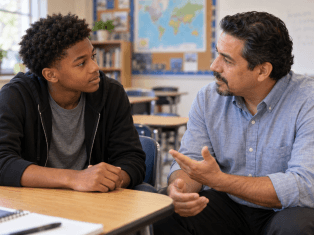
An educator might begin with a familiar concern: A student submits an impressive essay but cannot explain its argument. What did the student learn?
AI makes that question more urgent. Yet it also offers possibilities for learning. In a different experiment, college physics students using a carefully designed AI tutor showed stronger immediate learning gains than students receiving the comparison classroom instruction, which used active learning. That finding concerns two lessons and a particular tool; it does not tell us what happens to development over years.
Together, these studies suggest that the design of the help matters.
For teachers and parents, a useful question is: What is the young person still doing? Are they forming a question, making an attempt, weighing evidence, and revising an idea? Or are those activities being completed for them?
We should also be careful about celebrating struggle for its own sake. Confusion without support can discourage learning. Removing a barrier can make participation possible. The goal is to preserve meaningful opportunities to think and act while providing the help a learner needs.
For example, after a student uses AI to work through a mathematics problem, a teacher might offer a similar problem to try independently and invite the student to explain the reasoning. That gives both of them a clearer view of what the student understands and where further help is needed.
AI and Identity Development
Who helps us become ourselves?
I would want to ask about identity.
Adolescents explore who they are—their character, through friendships, family relationships, interests, disagreements, and experiences beyond familiar settings. What happens when a humanlike conversational system becomes another source of advice about who they might be or become?
Could it help a young person consider possibilities they had never encountered? Could its suggestions narrow their imagination? Could an agreeable response feel like confirmation of an identity that is still taking shape?
We do not yet have settled answers about the long term effects of these interactions.
There is a smaller finding worth considering. In an experiment involving short stories, access to AI-generated ideas improved ratings of individual stories, particularly for writers who scored lower on a creativity measure, while making the stories more similar to one another. That is evidence about a writing task—not proof that AI makes people’s identities alike. But it gives us a concrete reason to ask how assistance can expand individual possibilities while narrowing the variety of ideas a group produces.
At home or school, we might begin by giving young people space to express an initial thought before consulting AI. Afterward, we can ask: What surprised you? What do you disagree with? What matters here that the response missed?
Their disagreement may be as valuable as the answer. It gives them an opportunity to notice and express their own perspective.
AI and Human Relationships
What happens to our relationships?
A conversational tool can be available when another person is not. It can offer explanations, help organize thoughts, or provide a place to rehearse a difficult conversation.
I understand the appeal. I use AI myself.
But a relationship with another person includes another life: someone with needs, limits, commitments, and perspectives that do not always fit our own. Learning to listen, repair a misunderstanding, and care for someone when it is inconvenient involves experiences that a responsive conversation alone cannot provide.
The APA’s advisory raises concerns about young people’s interactions with humanlike AI systems and calls for safeguards, AI literacy, and adult involvement. Those concerns deserve attention without assuming that every young person will respond in the same way.
One practical question is where the interaction leads. Does rehearsing an apology help a young person have the actual conversation? Does exploring an interest lead them toward a club, mentor, or community? Or does time with the tool increasingly take the place of those connections?
For me, this brings the inner journey back into relationship with the world. We come to understand ourselves partly through encounters with people whose experiences differ from ours. As we consider AI’s place in young people’s lives, I hope we will continue to make room for those encounters.
AI and Agency
How do we remain authors of our lives?
This question feels especially personal at age 77.
I use AI to brainstorm health questions, to research decisions about where I want to travel, and to learn a variety of things that pique my interest. These explorations help me move toward the intentional next chapter I want to create.
I bring my history, relationships, grief, hopes, and values to those conversations. AI helps me investigate possibilities and organize information. I remain responsible for deciding what fits my life.
The word agency describes something of that experience: the capacity to make choices, take action, and influence what happens.
I experience agency as an energy from within. Yet that energy has never developed in isolation. Relationships, encouragement, opportunity, and experience help us discover what we can do. Self-determination theory offers a useful foundation here, emphasizing the importance of autonomy, competence, and relatedness—the experience of connection and belonging—in human motivation and growth. This established theory gives us a way to frame questions about AI. It does not establish what AI’s effects will be.
An inner compass can help us seek support as well as decide what to do with it. The question is whether that support helps us participate more fully in our lives.
That leaves an open question worth studying: Under what conditions can AI help someone develop the confidence and capacity to act? And when does its assistance leave them increasingly reliant on its direction?
Age alone does not settle this. Adults can defer too readily to a confident answer. Young people can use help thoughtfully. All of us need opportunities to notice whose judgment we are exercising.
Supporting Youth Development in the Age of AI
The Compass Advantage offers a shared language for reflecting on these questions. Its eight attributes—curiosity, sociability, resilience, self-awareness, integrity, resourcefulness, creativity, and empathy—can help us consider what we want young people to practice as they use new tools.
The Compass serves here as a developmental lens and a vocabulary for conversation. Research supporting its individual attributes does not establish how the framework as a whole works in AI education.
Teachers and parents might try a few simple conversations:
Invite a first thought. “Before we ask AI, what are you wondering? What might you try?” This makes room for curiosity and creativity.
Explore the help. “Which part helped you understand? Which part did the thinking for you?” This invites self-awareness about learning and resourcefulness in choosing support.
Make room for disagreement. “Does this response fit your experience? Whose perspective is missing?” This encourages reflection on our own views and attention to other people’s experiences.
Connect ideas to action. “What will you do next? Who else should be part of this conversation?” This brings the exploration into relationships and everyday life.
Reflect on responsibility. “What did you contribute, what needs checking, and what are you willing to stand behind?” This makes integrity part of the process.
These conversations give young people opportunities to reflect on their learning and choices; they have not been evaluated as an AI education program. Teachers can adapt them to students’ ages, needs, and classroom expectations for AI use.
The responsibility also extends beyond individual families and classrooms. Schools and technology companies make decisions about what tools encourage, what they reward, and how much control users have. Children’s opportunities to exercise agency are shaped by those decisions. A conversation about human development must include the environments we create for growth.
The Questions I Carry Forward
Retirement gives me a new vantage point on development. I am thinking about the lives young people are beginning while making choices about the life still ahead of me.
When I look back to Esalen in the 1970’s, I recognize a thread that has continued through my work: an interest in the inner journey and in the connections through which our lives take shape. That thread led me on a quest to understand our inner compass and how our actions affect the complex relationships around us. It now helps me frame the questions I bring to AI.
I am curious about what AI may make possible. I also want us to pay attention to the experiences through which people grow: asking their own questions, discovering what matters, caring for others, trying something uncertain, and learning that their actions can make a difference and have consequences.
When I began Roots of Action, I hoped to help adults see the strengths developing within children. As I leave, I hope we will bring that same attention to the age of AI. We can ask how our tools help young people practice those strengths, and whether the environments we create give them room to grow.
As I step away from writing regularly for Roots of Action, I hope we will keep asking what our tools make possible within us as well as around us. I hope the Compass Advantage and other developmental frameworks will remain useful invitations to that reflection—for young people and for those of us still finding our way into another chapter.
What are we learning? Who are we becoming? And how can we help one another live with greater intention?

References
American Psychological Association. (2025). Artificial intelligence and adolescent well-being: An APA health advisory.
Bastani, H., et al. (2025). Generative AI without guardrails can harm learning: Evidence from high school mathematics. Proceedings of the National Academy of Sciences, 122(26), e2422633122.
Doshi, A. R., & Hauser, O. P. (2024). Generative AI enhances individual creativity but reduces the collective diversity of novel content. Science Advances, 10(28), eadn5290.
Kestin, G., Miller, K., Klales, A., Milbourne, T., & Ponti, G. (2025). AI tutoring outperforms in-class active learning: An RCT introducing a novel research-based design in an authentic educational setting. Scientific Reports, 15, 17458.
Ryan, R. M., & Deci, E. L. (2000). Self-determination theory and the facilitation of intrinsic motivation, social development, and well-being. American Psychologist, 55(1), 68–78.
U.S. Department of Health and Human Services, ASPE. Positive Youth Development in the United States: Research Findings on Evaluations of Positive Youth Development Programs. Historical overview of the field and its research foundations.
Other Articles You May Enjoy
Successful Kids Need 8 Core Abilities: How to Parent With Purpose
Published: October 28, 2026